
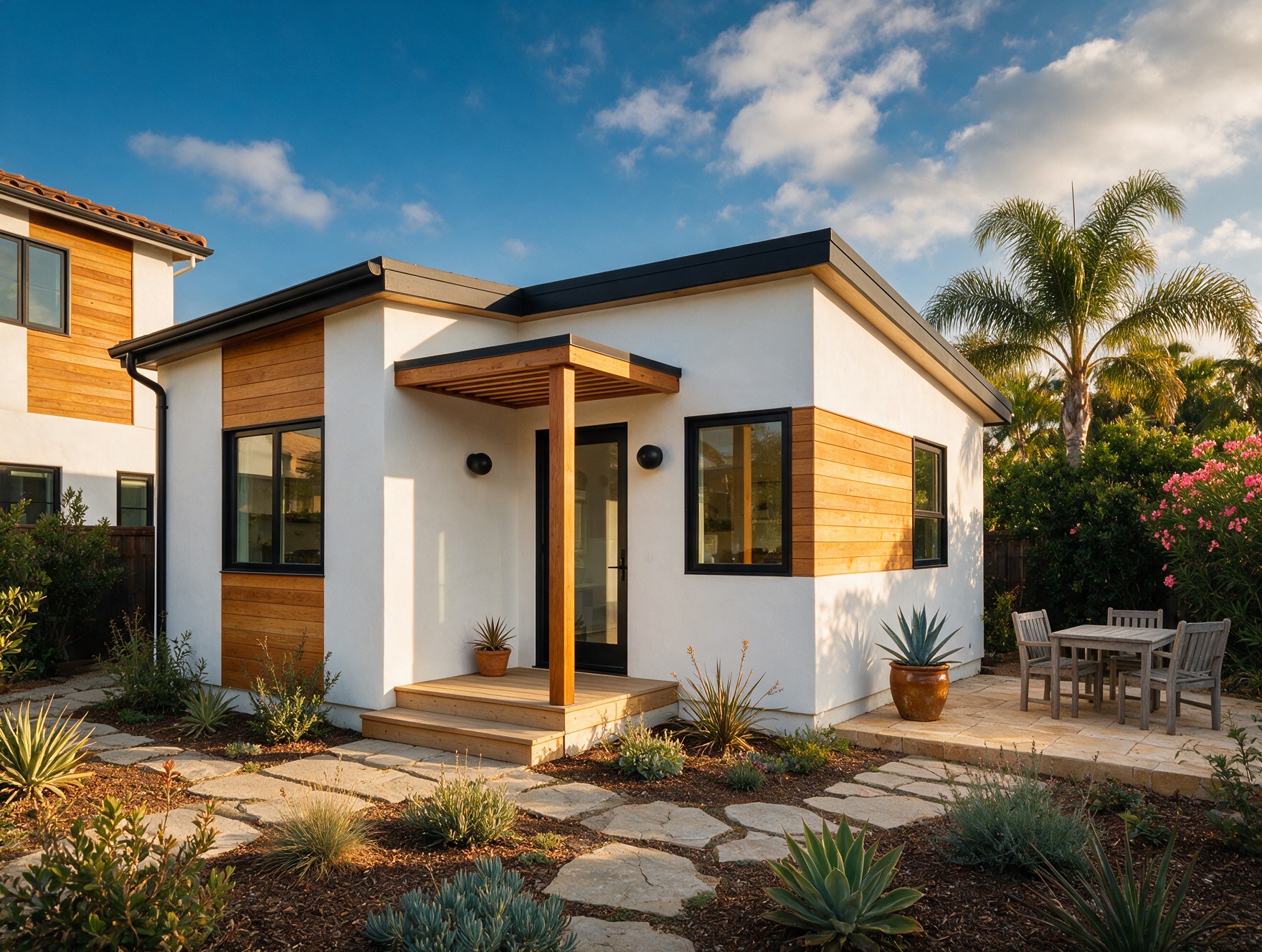
If you want more living space on your San Diego property, you usually have two good paths. You can build a brand-new detached ADU in your yard, or you can convert your garage into a living space.
Both are smart. Both are legal when done right. But they are not the same, and the one that’s “best” depends on your lot, your budget, and what you want out of the space.
Let’s walk through it the honest way.
The quick version
- A detached ADU is a new standalone home in your backyard. It has its own foundation, walls, roof, and utilities. These generally start around $150,000 and go up from there.
- A garage conversion turns the garage you already have into a finished room with a kitchen and bath. It usually costs less, because the foundation and shell are already there.
So the first big question is simple: do you want to build something new, or use what you already have?
Why a garage conversion costs less
When we convert a garage, a lot of the hard, expensive work is already done. The slab is poured. The walls are up. The roof is on.
Most of your money goes into making it a real, comfortable home: insulation, drywall, flooring, a kitchenette, a full bathroom, heating and cooling, and the electrical and plumbing to support it all.
That’s why a conversion is often the budget-friendly choice. You’re finishing a space, not creating one from scratch.
The trade-off? You give up your garage. If you use it for parking, storage, a workshop, or a home gym, you’ll want to think about where all that goes.
Why a detached ADU costs more (and what you get)
A detached ADU is a true new build. New foundation. New framing. New roof. New utility lines run out to the unit. That’s real work, and it’s the reason the number starts higher.
But you also get more:
- Better light and privacy — it’s a separate building, not an attached room.
- A layout built on purpose — you’re not working around an old garage shape.
- More long-term value — a well-built, separate home in the backyard is a strong asset.
If you’re planning for aging parents, adult kids, or steady rental income, a detached unit often feels more like a real home — because it is one.
How to pick (the simple test)
Here’s the honest way we help homeowners decide:
Lean toward a garage conversion if:
- You want to spend less.
- You don’t really need the garage.
- The garage’s size and spot on your lot work for what you have in mind.
Lean toward a detached ADU if:
- You want more light, privacy, and a purpose-built layout.
- You want the most long-term value.
- Your budget and your lot can support a new build.
Neither choice is “better” across the board. A good contractor will look at your actual property and tell you straight which one fits — even if it’s the less expensive option. That’s our job: to educate, not to upsell.
The one thing that matters most either way
Whichever path you pick, it has to be built legal — permitted, engineered, and inspected.
This is the biggest mistake we see. Someone converts a garage on the cheap, with no permits, to save money up front. Then it comes back to bite them at resale, at refinance, or with the city.
A permitted ADU is an asset that adds value. An unpermitted one is a liability that costs you later. We only build them the right way.
The good news: California’s statewide ADU laws over the last few years made both paths much easier than they used to be. More homeowners qualify, and the process is more predictable.
What a real project includes
No matter which one you choose, a proper ADU project covers:
- Feasibility and planning — checking your setbacks, utilities, and what your lot allows before you spend on drawings.
- Permits and engineering — so it’s legal, safe, and financeable.
- Full utilities — electrical, plumbing, and heating/cooling done to code.
- A real finished interior — a proper kitchen or kitchenette, a full bath, and durable finishes that feel like home.
Want help deciding? We’re happy to look at your lot and give you an honest read — no pressure. Reach out here, learn more on our ADU page, or see the areas we serve like La Mesa and El Cajon.